Undergraduate · NYU Shanghai

Zhuoyan Yu.

I work on language models for code
and how we evaluate them.

At NYU Shanghai, I work on code generation, LLM-generated tests, and behavior-preserving repair of research software. I also work on computer vision, with experience in medical imaging and multimodal systems.

Selected research

Publication
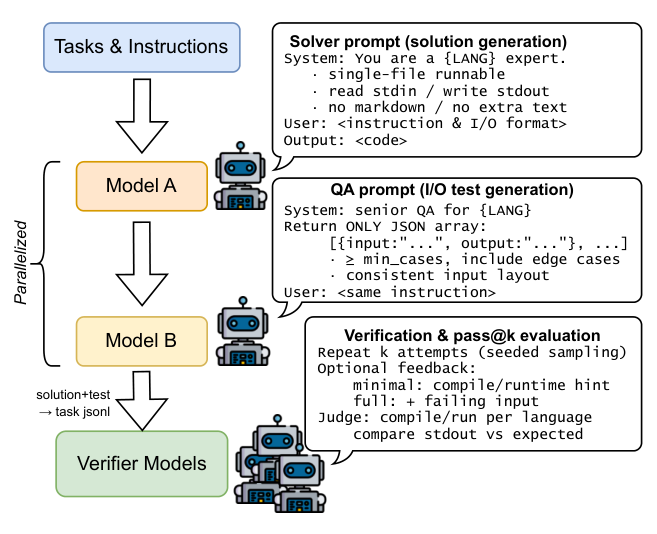
CodeFORGE diagram: separate solution and test generation followed by model-based verification.
Separate generation. Executable verification.
IJCNN 2026LLMs for code

CodeFORGE: Framework for Orchestrated Rare Programming Language Generation and Evaluation

Zhuoyan Yu, Minghao Shao, Yijun Shen, Yichen Zhao, Boyuan Chen, Yik-Cheung Tam, Muhammad Shafique

An executable benchmark of 1,196 verified tasks across 12 rare and legacy languages. Separates solution synthesis from test generation and uses a Docker-based verification pipeline with model cascading.
Explore the CodeFORGE framework
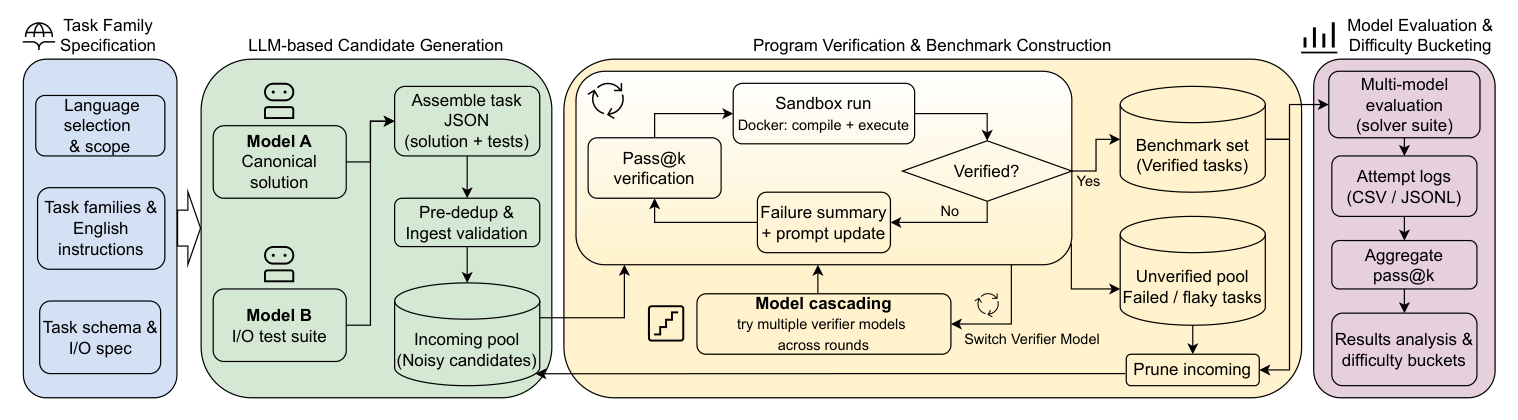
CodeFORGE framework: task specification, candidate generation, sandbox verification, benchmark construction, and model evaluation.
Framework overview from the paper, Figure 2. Candidate tasks pass through isolated execution and feedback-driven verification before entering the benchmark.

© 2026 IEEE. Personal use of this material is permitted. Permission from IEEE must be obtained for all other uses, in any current or future media, including reprinting/republishing this material for advertising or promotional purposes, creating new collective works, for resale or redistribution to servers or lists, or reuse of any copyrighted component of this work in other works.

Research & experience

2025 — present
Sep 2026 — presentOngoing research

RepoRevive: Research-Code Diagnosis and Repair

Advanced Capstone Project · NYU Shanghai

Extended team tooling to index 15,343 paper records across 12 CVPR, ICCV, and ECCV editions and identify 5,283 distinct candidate repository URLs. Designed AI-assisted diagnosis workflows that separate static risks from runtime failures, with fixed task baselines and before/after evidence.

Coordinated and reviewed task-level functional repairs in DeamNet, PReNet, and SoftRas, addressing API compatibility failures and visual artifacts missed by basic execution checks.

Jun 2026 — presentOngoing research

LLM Test Generation: Self-Leniency and Framework Evaluation

Serendipity Research Group · NYU Shanghai

Studying how same-model and cross-model tests expose faults, with and without access to candidate code. Built Docker-isolated evaluation with a three-reference agreement oracle; curated project data comprise 139 distinct faulty programs across 59 LiveCodeBench problems, passing public but failing private tests.

Compared LCB-adapted Direct, TestChain, and ConVerTest under a shared protocol for fault detection, expected-output correctness, and API cost. Case analysis identified how shared semantic errors in auxiliary solutions can retain incorrect assertions and discard fault-revealing tests.

May — Aug 2026Research internship

Ant Technologies U.S.

Algorithm Engineer Intern (Research) · Medical and Healthcare AI Lab

Developed nnU-Net v2 pipelines for cerebral microbleed and lacune detection in multimodal MRI. Worked on spatial alignment, data validation, controlled ablations, and lesion-level evaluation.

Sep 2025 — Apr 2026Research assistant

CodeFORGE

Serendipity Research Fellowship · NYU Shanghai

Built benchmark generation and verification tooling for rare and legacy programming languages, including Docker-based pass@k evaluation, feedback-driven resampling, and API cost controls.

Earlier research includes long-video understanding and chest X-ray interpretation. See the full CV

Selected projects

Vision, multimodal systems & AI for learning
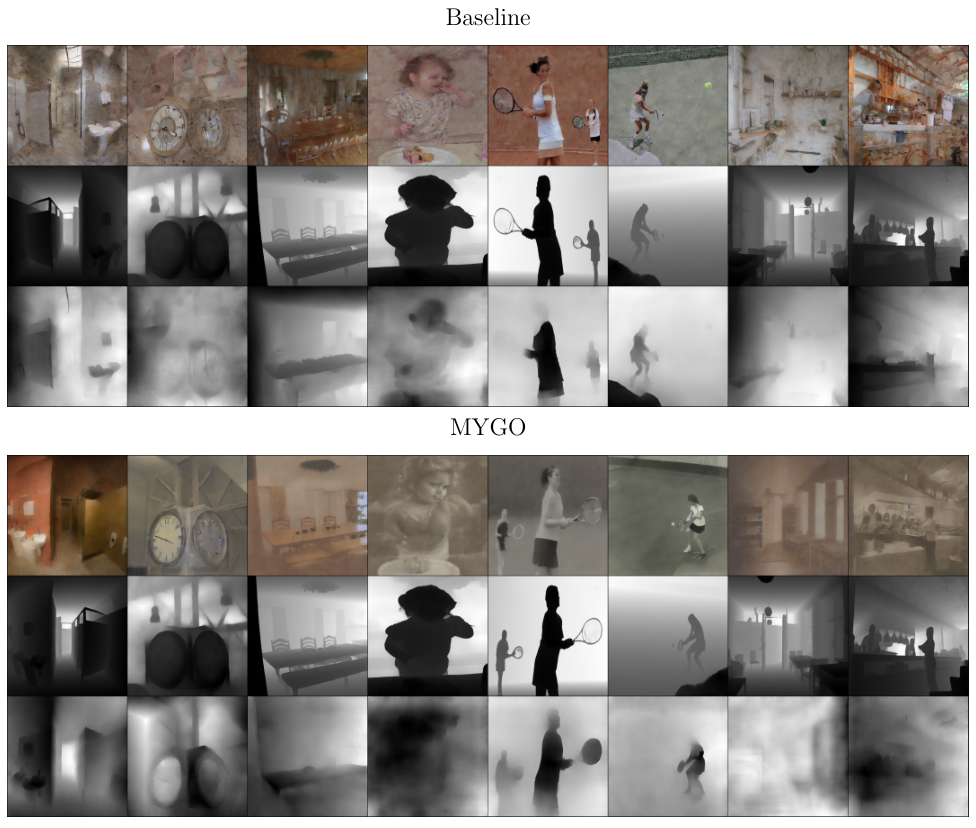
Qualitative examples from the MYGO report: baseline and MYGO generated images, conditioning depth, and predicted depth.
Qualitative comparison · project report, Fig. 3

Course project Sep — Dec 2025

MYGO: Geometry-Aware Depth ControlNet

Exploring how depth representation affects image generation. Co-designed an 18-channel conditioning signal for Stable Diffusion 1.5 ControlNet, combining raw depth, 16 ordinal layers, and occlusion boundaries.

Compared with a single-channel baseline on 50k COCO images under a matched 20k-step training budget.

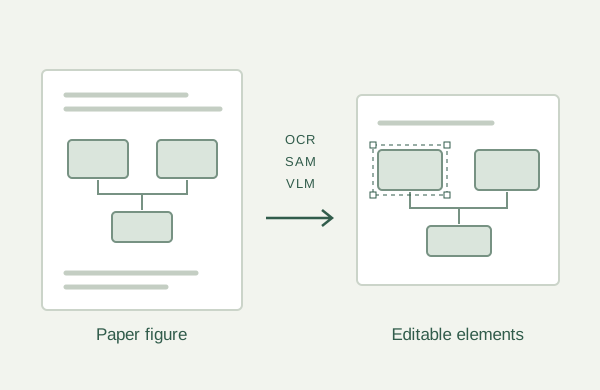
Method illustration: OCR, segmentation, and visual language understanding convert paper figures into editable slide elements.
Method illustration

Research project May — Aug 2025

Agentic Figure Transcription for Scientific Papers

A prototype that turns academic figures into editable PowerPoint slides. Combines OCR, SAM segmentation, region-level vision-language classification, and recursive segmentation of small objects.

Research Assistant · CSDSE Department, NYU Shanghai

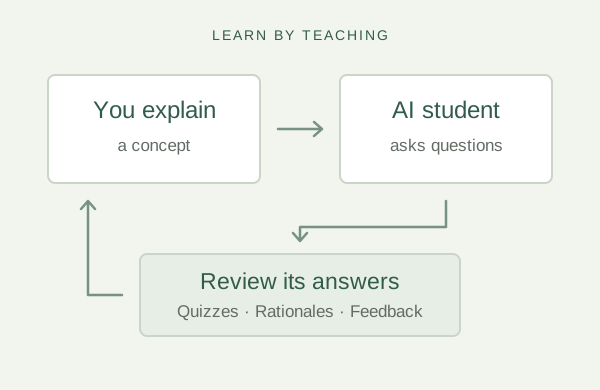
Curistro learning loop: explain a concept to an AI student, answer its questions, then review its answers and refine your explanation.
Learning-by-teaching workflow

AI for learning Dec 2024 — Apr 2025

Curistro: Learning by Teaching

A learning app where users teach an AI student, respond to its questions, and review its understanding through quizzes and feedback. Built with Xiongfeng Li for the NYU Shanghai Digital Innovation Challenge.

Implemented the Flask/Jinja2 interface, quiz generation across four dimensions, structured response parsing, and in-memory storage.

Best Innovation Award · NYU Shanghai DIC 2024–25 · Team award

Get in touch

Let’s talk research.

For research conversations and collaboration, email is the best way to reach me.